




October 17, 2026 / Dental Implant Education
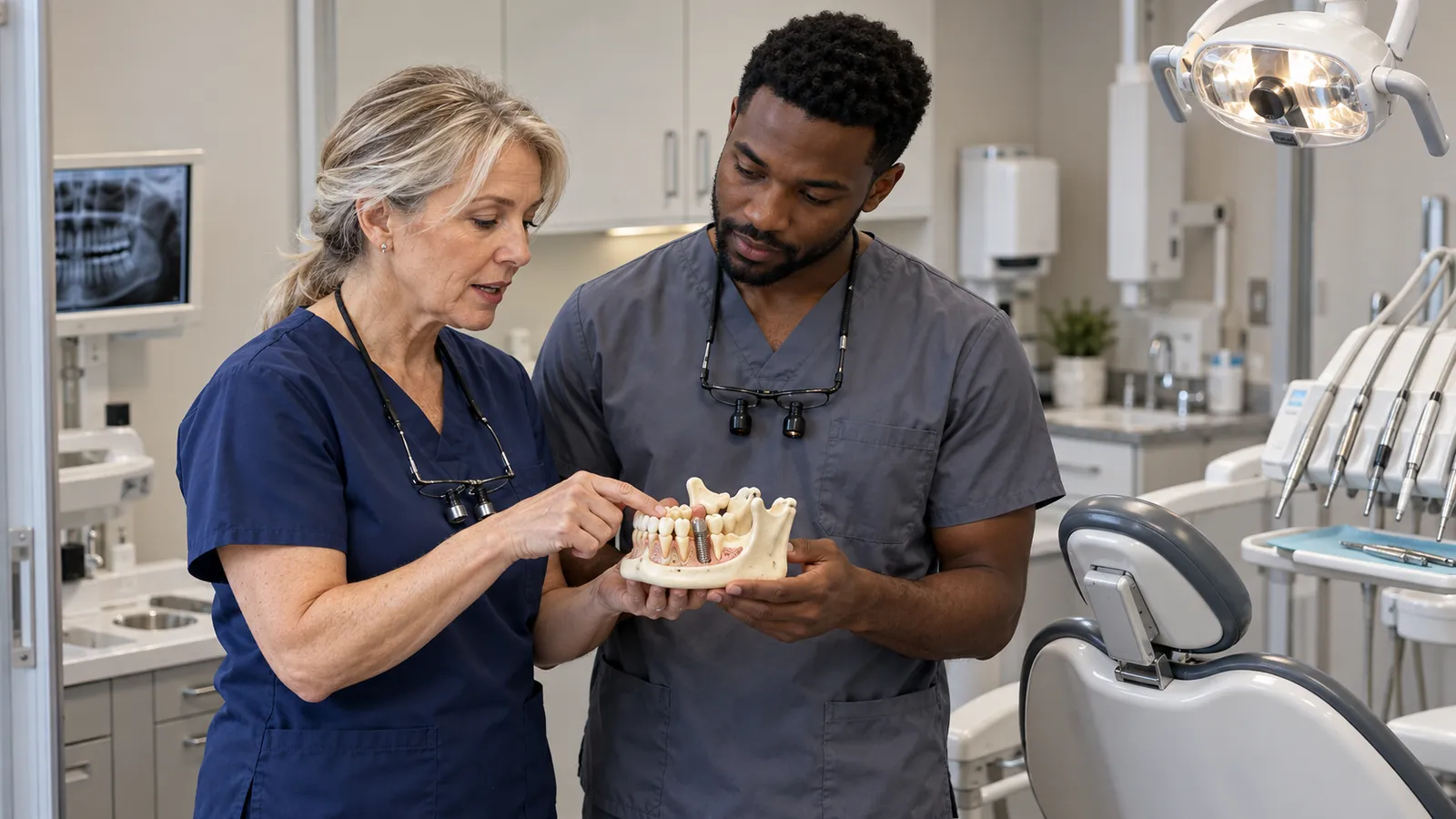
A new implant dentist should seek case review whenever diagnosis, anatomy, restorative design, risk, sequencing or personal experience leaves an important question unresolved. Review is most useful before irreversible treatment, with adequate records and specific questions. A case does not need to look dramatic to deserve a second set of experienced eyes.
Dental implants mentorship can help turn uncertainty into a defined next step: gather more information, revise the plan, arrange appropriate support or refer. It does not replace the treating dentist's judgement, informed consent, applicable professional standards or responsibility for the care provided.
The following framework is for preparing a useful pre-treatment conversation. It is not a surgical protocol or a checklist that certifies a case as suitable to proceed.
A vague concern is easier to explore before a patient has committed to a particular sequence or an irreversible step has been taken. Waiting until the day of surgery can turn a manageable planning question into pressure to improvise.
For example, a clinician may feel comfortable with placement in a healed site but be uncertain about the proposed final restoration. Another may understand the restorative goal but lack experience with an anticipated surgical requirement. Both uncertainties deserve attention before treatment; neither is resolved simply because the other part of the case looks familiar.
The ITI's SAC classification provides a structured way to consider complexity and risk across surgical and restorative implant care. Its Straightforward, Advanced and Complex categories support assessment and communication. They should prompt examination of the relevant factors, not become a reassuring label detached from the records or the operator's experience.
Fusion Implant Dentistry describes one-to-one dental implant mentorship for general dentists at different experience levels. When enquiring, explain the decision you need help with and confirm the scope of support. Do not assume that a case discussion includes supervision, attendance at treatment or immediate availability for complications.
Begin with what you cannot yet explain confidently. Is the diagnosis established? Are the patient's goals compatible with the proposed restoration? Do you understand the anatomical constraints and the information still needed? Is there a part of the plan that exceeds your training or practical experience?
A useful review request names the uncertainty rather than asking, “Does this look okay?” Examples include:
These are prompts for discussion, not diagnostic criteria. The answer may be more records, a different design, further education or referral. A mentor should not have to infer the gap from a collection of screenshots.
For Ontario dentists, the RCDSO's implant dentistry guidance connects the complexity of undertaken care with training, competence and experience. Check the regulator's current requirements when planning care; a mentor's confidence in a procedure does not establish your own readiness to provide it.
Prepare enough context for the question being asked. An isolated radiographic view may illustrate one concern while omitting the restorative goal, clinical findings or relevant history. Start with a concise case summary and identify what is incomplete.
Depending on the case and the review question, useful material may include:
Confirm with the mentor what records are required and how they should be shared. Follow your obligations for patient information, consent and secure transfer. Do not send identifiable records through an informal channel simply because it is convenient.
Separate observations from assumptions. “I have not yet obtained this information” is useful; quietly filling the gap with a guess is not. If a finding has changed since the records were taken, flag the change. The purpose is a review of the current patient and plan, not an idealized version of the case.
Discuss the intended restoration before treating the surgical appointment as a standalone task. Ask how each planned step supports the final prosthesis, and what information the surgical and restorative clinicians need from one another.
Useful mentor questions include: What decision must be settled before placement? What would make the proposed sequence unsuitable? Which assumptions should be verified rather than carried forward? What would prompt a change to the provisional or definitive plan?
Include the time between stages. Ask who will review healing, who communicates restrictions and how the patient will be managed if a stage is delayed. A technically detailed surgical plan can still leave practical gaps in responsibility.
Talk through alternatives before a problem forces the discussion. If the findings differ from what was anticipated, which decisions can safely be deferred and which require a different provider or setting? The aim is to establish limits and escalation arrangements, not to collect improvised instructions for unfamiliar surgery.
If broader knowledge gaps emerge, case review may need to be paired with additional education. Fusion's structured implant education is a separate offering to explore. Confirm its current format, entry requirements and suitability directly; a program description alone does not demonstrate that an individual dentist has met every applicable obligation.
Referral is appropriate when the patient's needs exceed the care you can competently provide in the available setting, or when unresolved concerns require expertise or resources you do not have. Mentorship should help you recognize that boundary, not persuade you to cross it.
Distinguish an educational discussion from an agreed clinical role. A mentor who comments on a plan has not necessarily accepted responsibility for providing treatment, reviewing the patient or managing an emergency. Clarify what each person has actually agreed to do and communicate the arrangement accurately.
A referral can still be part of professional development. Ask, with appropriate patient authorization, how findings and the eventual plan can be communicated back. Learning why a case was referred is more valuable than simply recording that it was “too difficult.”
Fusion's article on progressing from simple to complex implant cases addresses the broader learning journey. For the case in front of you, the immediate question is narrower: what does this patient need, and can you provide it safely within your competence and agreed support?
After review, summarize the decisions in the clinical record. Distinguish the advice received from the decisions you have made, and record the information on which they depend. Do not turn a conditional suggestion into unconditional approval.
A practical closeout is to identify:
For example, “obtain further assessment before confirming the plan” is an action to complete, not permission to book the procedure while the answer is pending. If later findings change the assumptions, reopen the discussion rather than relying on earlier feedback.
Explain material changes to the patient and complete the relevant consent discussion before treatment. Keep the reasoning understandable enough that another clinician can follow it. The value of mentorship is not the existence of a message saying the case was reviewed; it is the effect of that review on a defensible care plan.
No. New techniques, unfamiliar restorative demands or a change in case complexity can create a need for review later in practice. Match the question and the support to your actual experience rather than the number of years since graduation.
Yes, when important information or experience is missing. Appearance alone does not establish complexity or operator readiness. Be specific about the uncertainty so the review can address it rather than simply endorse a label.
Relevant history, clinical findings, appropriate imaging, restorative information and a proposed sequence can help. The exact requirements depend on the question. Ask the mentor what is needed and identify missing or outdated information clearly.
Incomplete records may permit a discussion of questions or possible next steps, but they can limit a case-specific judgement. Establish what further assessment is required before relying on a recommendation. Do not mistake a preliminary conversation for a completed evaluation.
Refer when the required care exceeds your competence or available resources, or when specialist assessment is needed to resolve the problem. Clarify responsibilities and the handoff rather than assuming mentorship itself changes the limits of your practice.
To explore support for case planning, contact Fusion Implant Dentistry with a description of your experience and the type of review you need. Ask about the current mentorship format, records process and scope of involvement before sharing a case or arranging treatment around anticipated support.

Welcome to Fusion Implant Dentistry! Led by Dr. Sajid Syed, Fusion Implant Dentistry offers implant courses, mentorship, and residency programs designed to elevate your clinical expertise and operational success.